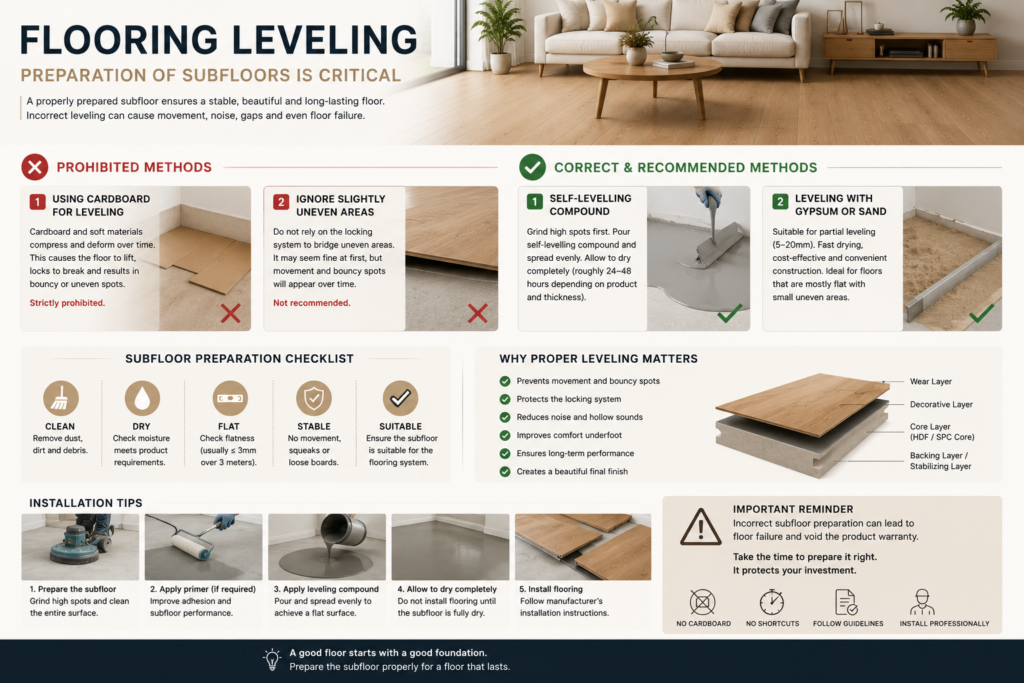
Proper subfloor preparation and flooring leveling is one of the most important steps before installing wood flooring, laminate flooring, or SPC flooring.
Some homeowners may choose DIY installation to save labour costs. However, even if the flooring product is easy to install, the subfloor must still be properly prepared. One of the most common installation problems is an uneven subfloor.
If the floor is installed over an unsuitable or uneven surface, it may lead to movement, hollow spots, noise, joint stress, locking system damage, or premature flooring failure.
Before installation, the subfloor should be clean, dry, flat, stable, and suitable for the flooring system.
Common Incorrect Methods
1. Using Cardboard for Levelling
Cardboard, paper, packaging material, or other soft temporary materials should not be used for subfloor levelling.
These materials may compress, deform, absorb moisture, or break down over time. Once this happens, the flooring above may start to move, feel soft underfoot, or create a floating sensation.
For click-lock flooring systems, this movement can place stress on the joints and may eventually damage the locking system.
Using cardboard or similar materials for levelling is not an acceptable subfloor preparation method.
2. Installing Over Slightly Uneven Areas Without Correction
Some installers may choose to ignore minor uneven areas and rely on the strength of the flooring locking system to bridge the gap.
This is not recommended.
Although the floor may appear acceptable immediately after installation, movement may become noticeable over time. The affected area may feel bouncy, hollow, or unstable when walked on.
Uneven subfloors can place repeated stress on the locking system, which may lead to gaps, noise, joint damage, or floor failure.
Even small uneven areas should be assessed and corrected according to the manufacturer’s flatness requirements before installation.
Recommended Subfloor Levelling Methods
1. Grinding High Spots
Before applying any levelling compound, high spots should be identified and reduced where required.
Grinding or sanding raised areas can help create a flatter and more stable surface. Dust and debris must be removed thoroughly after grinding.
This step is important because simply filling low areas without correcting high spots may still leave the subfloor uneven.
2. Self-Levelling Compound
Self-levelling compound is commonly used to correct uneven concrete subfloors.
The surface should be properly cleaned and prepared before application. Primer may be required depending on the product and subfloor condition.
The self-levelling compound should be mixed and applied strictly according to the manufacturer’s instructions. Water ratios, working time, minimum and maximum thickness, drying time, and moisture requirements must all be followed.
After application, the floor must be allowed to dry and cure fully before flooring installation begins. Drying time depends on the product, thickness, temperature, humidity, and site conditions.
Do not install flooring until the levelling compound is fully cured and the subfloor moisture condition is suitable.
3. Localised Patching or Repair
For small low areas or minor uneven sections, a suitable floor patching compound may be used.
This method can be useful where the subfloor is generally flat but has isolated dips or imperfections. It can help correct localised unevenness without raising the entire floor level.
The patching material must be suitable for the subfloor and flooring system. It should also be allowed to dry fully before installation.
4. Timber or Panel Subfloor Correction
For timber, plywood, or particleboard subfloors, loose panels, squeaks, movement, damaged boards, or uneven joints should be repaired before installation.
Raised joints may need sanding. Loose panels may need to be properly fixed. Damaged or unstable sections should be replaced where required.
The subfloor must be stable before floating or glue-down flooring is installed.

Why Subfloor Preparation Matters
A good flooring installation starts with the subfloor.
Even a high-quality flooring product can perform poorly if installed over an uneven, damp, unstable, or contaminated surface.
Proper subfloor preparation helps:
- Reduce floor movement
- Protect the locking system
- Improve walking comfort
- Reduce hollow sounds and noise
- Support long-term flooring performance
- Improve the final appearance of the floor

Final Reminder
Do not use cardboard, soft packing material, or temporary fillers to level a floor.
Do not ignore uneven areas and expect the flooring system to compensate for the problem.
Before installing wood flooring, laminate flooring, or SPC flooring, always check the subfloor condition and follow the manufacturer’s installation requirements.
If the subfloor is uneven or unsuitable, it should be corrected before installation begins. For best results, subfloor preparation and flooring installation should be carried out by a competent flooring installer.