Open-plan kitchens, laundries, dining areas, and living spaces place different demands on a floor. In these connected areas, the flooring needs to look calm and consistent, but it also needs to handle everyday household use such as foot traffic, cleaning, small spills, damp shoes, pet bowls, and regular movement between rooms.
This is where flooring selection becomes important. Many homeowners want the warmth and natural appearance of wood flooring, but some areas of the home may require stronger moisture resistance than traditional timber-based products can provide.
The key point is simple: water resistance and waterproof performance are not the same thing.
A floor that can handle an occasional spill may still be affected if moisture sits on the surface for too long or enters through joints, edges, or poorly detailed areas. This is especially important in kitchens and laundries, where spills, splashes, wet cleaning, appliances, and humidity may place extra pressure on the flooring system.
For this reason, the best flooring choice is not only about appearance. It also depends on the product construction, installation method, subfloor condition, joint protection, perimeter detailing, and ongoing maintenance.
Why Moisture Performance Matters in Open-Plan Kitchens and Laundries
Open-plan design creates visual flow and makes a home feel larger, brighter, and more connected. Many homeowners prefer one continuous flooring surface from the kitchen through to the dining and living areas because it looks cleaner and avoids awkward transitions between rooms.
However, these spaces do not all behave the same way.
Living rooms are usually dry areas. Kitchens are exposed to food spills, cleaning, cooking activity, and regular foot traffic. Laundries can be more moisture-prone due to washing machines, damp clothing, detergent spills, and occasional appliance leaks.
When one floor is used across all these areas, the selected product needs to balance appearance, comfort, durability, and moisture resistance. A product that works well in a dry living room may not always be the most practical choice beside a sink, laundry appliance, or wet cleaning area.
A suitable flooring option for open-plan kitchen and laundry spaces should generally offer:
- Good dimensional stability
- Practical resistance to everyday surface moisture
- Easy cleaning and maintenance
- A comfortable feel underfoot
- A consistent appearance across larger areas
- Suitability for the intended room use
- Clear installation and maintenance requirements
The final performance of any flooring system depends on correct product selection, proper subfloor preparation, suitable installation, and ongoing care in accordance with the manufacturer’s guidelines.
Comparing Wood Flooring and Wood-Look Flooring Options
Many people searching for wood flooring are looking for the warmth, texture, and visual appeal of timber. In moisture-prone areas, however, it is also important to consider whether a real wood product or a wood-look alternative is more suitable.
Some flooring products are made from real timber or wood-based materials. Others are designed to provide a timber-look appearance with improved water resistance and easier maintenance.
The table below provides a general comparison of common flooring options for open-plan kitchens, laundries, and connected living spaces.
| Flooring Type | Moisture Performance | Look and Feel | Suitable Use in Open-Plan Spaces | Main Watch-Out |
|---|---|---|---|---|
| Solid timber | Limited in moisture-prone areas | Authentic natural timber | Best suited to dry living areas, bedrooms, and feature spaces | Can be affected by swelling, cupping, staining, and movement |
| Engineered wood | More stable than solid timber, but still moisture-sensitive | Real timber veneer | Living, dining, bedrooms, and selected open-plan areas away from frequent moisture | Not usually suitable as a waterproof flooring system |
| Laminate flooring | Varies by product | Realistic timber-look surface | Living areas, bedrooms, hallways, and some kitchens where approved by the manufacturer | HDF core and joins may be vulnerable if moisture enters |
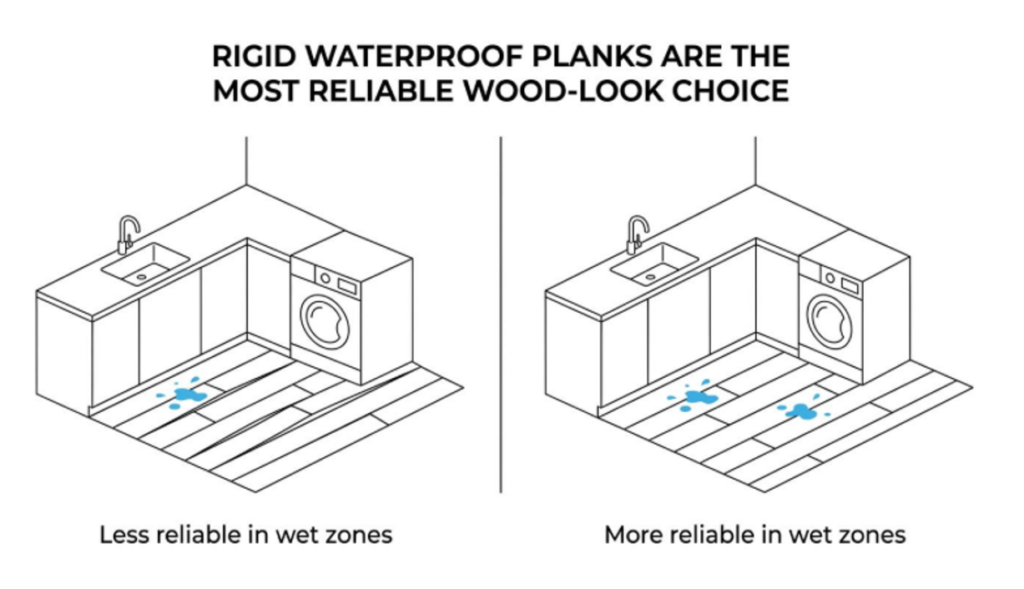
| SPC flooring | High water-resistant performance when correctly installed | Wide range of timber-look designs | Kitchens, living areas, rental properties, apartments, and selected commercial spaces | Harder feel underfoot than real timber; installation detailing still matters |
| VSPC flooring | High water-resistant performance when correctly installed | Refined and stable timber-look appearance | Large open-plan areas where design consistency and practical performance are important | Product quality and specification vary between brands |
| Tiles | High water resistance when correctly detailed | Wide range of designs | Kitchens, laundries, bathrooms, and wet areas | Colder and harder underfoot; grout maintenance may be required |
For many modern homes, SPC and VSPC flooring provide a practical option where homeowners want a timber-look surface with stronger moisture resistance than traditional wood-based flooring products.
Tiles remain a strong option for laundries and wet areas, particularly where water exposure is more frequent. However, many homeowners prefer the warmer look and continuous visual flow of timber-look planks across open-plan kitchen, dining, and living spaces.
The right choice depends on the room layout, expected moisture exposure, subfloor condition, installation method, design preference, and maintenance expectations.
Can Real Wood Flooring Work in a Kitchen or Laundry?
Real wood flooring has a natural appeal that is difficult to replace. It brings warmth, depth, and genuine timber character to a home. In dry areas such as living rooms, bedrooms, hallways, and dining spaces, timber and engineered wood flooring can be an excellent choice.
In kitchens and laundries, however, the decision requires more care.
Wood is a natural material, and it responds to moisture, humidity, temperature change, and site conditions. If a timber-based floor is exposed to repeated spills, standing water, wet cleaning, or moisture entering through joints and edges, it may be affected by expansion, contraction, staining, cupping, or other forms of movement.
Solid timber is generally not recommended for laundries and should be considered carefully in kitchens where regular moisture exposure is expected. Even when a timber floor has a protective surface finish, it is still not usually intended to perform as a waterproof flooring system.
Engineered wood flooring offers better dimensional stability than solid timber because of its layered construction. It can work well in many open-plan living and dining areas, especially where the space is generally dry and well maintained. However, most engineered wood products are still timber-based and should not be treated as waterproof flooring.
This does not mean real wood flooring has no place in open-plan design. It simply means the product must be selected according to the room conditions. In drier areas, engineered wood or timber flooring may be suitable. In moisture-prone areas such as laundries or kitchens with frequent spills, a more water-resistant wood-look flooring option may be more practical.
SPC and VSPC Flooring for Timber-Look Performance
SPC flooring, short for Stone Plastic Composite, is a rigid plank flooring option that is often selected where homeowners want a timber-look surface with practical water-resistant performance.
Its rigid composite core provides good dimensional stability and makes it less moisture-sensitive than many traditional wood-based flooring products. This can make SPC flooring a practical option for kitchens, open-plan living areas, rental properties, apartments, and selected commercial spaces, depending on the product specification and installation requirements.
VSPC flooring is another timber-look rigid flooring option that may be suitable for larger open-plan areas where visual consistency, stability, and practical maintenance are important. Depending on the product, it can provide a refined appearance while supporting everyday use in busy interiors.
These flooring categories are popular because they can offer:
- Timber-look designs in plank formats
- Strong dimensional stability
- Practical resistance to everyday surface moisture
- Easy day-to-day cleaning
- Good suitability for open-plan layouts
- A practical balance between appearance and maintenance
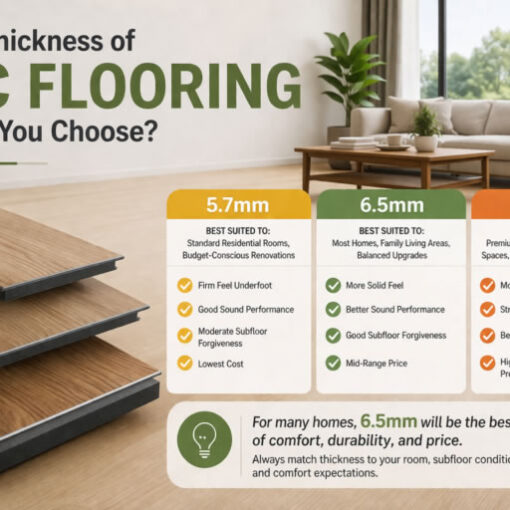
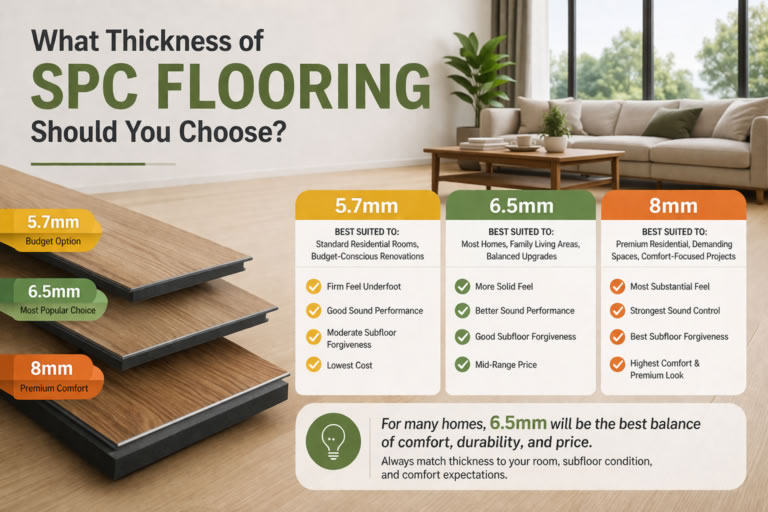
However, not all SPC or VSPC products perform the same. Thickness, wear layer, backing quality, locking system, surface texture, installation method, and brand standards all influence the final result.
It is also important to understand that water-resistant flooring is not a substitute for correct installation or proper building detailing. Perimeter sealing, expansion allowances, subfloor preparation, trims, joint quality, and maintenance instructions all affect long-term performance.
Laminate Flooring in Kitchens and Laundries
Laminate flooring deserves a careful and balanced assessment. Older laminate products built a reputation for swelling when exposed to moisture, but many modern laminate ranges now offer improved surface protection, tighter locking systems, and better resistance to everyday spills.
In a kitchen, a suitable water-resistant laminate may be a practical option where spills are cleaned promptly and the floor is installed in accordance with the manufacturer’s instructions.
In a laundry, the risk level is usually higher. Washing machines, damp clothing, detergent spills, appliance leaks, and more frequent wet cleaning can place extra pressure on the flooring joints and edges. For this reason, SPC, VSPC, or tiles are often considered ahead of laminate where stronger moisture resistance is required.
If laminate flooring is being considered for a kitchen or laundry, the key questions are:
- Is the product water-resistant or marketed as waterproof?
- What does the manufacturer allow regarding standing water?
- Are the joins or edges protected?
- Is the product approved for kitchens, laundries, or only dry areas?
- What installation and maintenance conditions apply?
These details matter more than general marketing phrases.
Best Flooring Choices for Different Open-Plan Needs
There is no single flooring option that suits every project. The best choice depends on how the kitchen, laundry, dining, and living areas are connected, how much moisture exposure is expected, and how important visual continuity is to the design.
For many homes, the following combinations may work well:
- SPC or VSPC throughout open-plan areas
A practical choice where visual continuity, water-resistant performance, and easy maintenance are important. - Tiles in the laundry, timber-look planks elsewhere
A useful option where the laundry is enclosed or separated from the main living space. - Engineered wood in dry living areas, with SPC, VSPC, or tiles in moisture-prone zones
Suitable where transitions can be handled neatly and the layout allows a change of surface. - Laminate in dry and selected kitchen areas
May be suitable where the product is approved for the intended use, moisture exposure is limited, and spills are cleaned promptly.
In true open-plan layouts, one continuous floor often creates the calmest and most refined appearance. It can also make everyday movement easier and reduce the number of floor transitions.
Where the goal is a timber-look floor with practical moisture resistance, rigid plank flooring such as SPC or VSPC is often a balanced option.
Design Details That Affect Appearance and Performance
Once the flooring category is selected, the design details become important. Colour, plank size, texture, surface finish, and installation direction all influence how the floor looks and performs in the space.
Lighter oak tones can make open-plan rooms feel brighter and more spacious. Mid-tone timber looks often provide a practical balance between warmth and easy maintenance. Very dark floors can create a dramatic effect, but they may show dust, lint, scratches, and water marks more easily.
Performance is also influenced by design and product details, including:
- Surface texture: A lightly textured surface can create a more natural look and may improve underfoot grip compared with very smooth finishes.
- Plank size: Longer planks can suit larger open-plan areas, while medium plank formats may feel more balanced in smaller homes.
- Locking quality: A well-made locking system supports better joint stability and installation performance.
- Underlay requirements: Acoustic comfort, underfoot feel, and subfloor compatibility should be checked before installation.
- Batch consistency: Large projects should confirm stock availability and batch continuity before purchase.
For larger floor areas, stock availability is not a small detail. Colour continuity, replacement planning, and project timing can all be affected by whether the supplier has enough landed stock available.
Installation and Moisture Control
A flooring product is only as reliable as the installation around it.
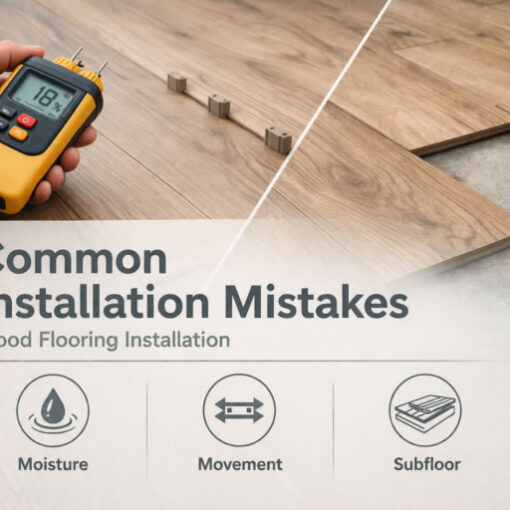
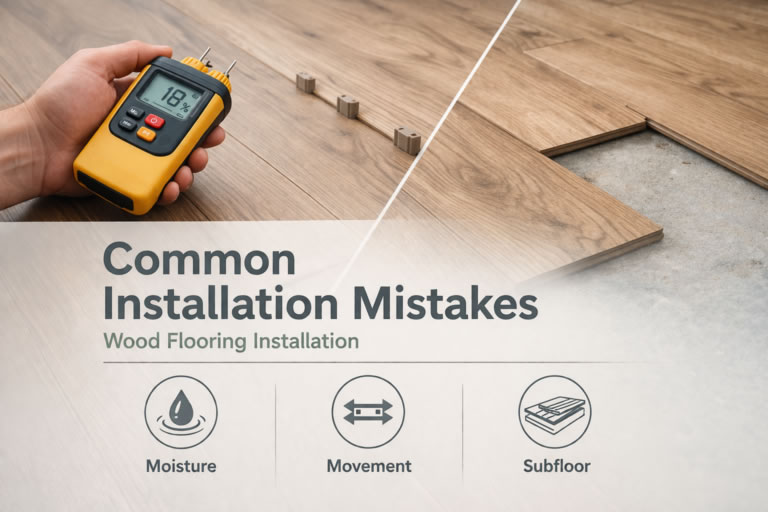
Even a high-quality water-resistant plank can perform poorly if the subfloor is not suitable, if moisture conditions are ignored, or if expansion and perimeter detailing are not followed.
Before installation, the subfloor should be clean, dry, flat, stable, and prepared in accordance with the flooring manufacturer’s requirements. Any high spots, low spots, loose material, surface contamination, or moisture concerns should be addressed before the flooring is installed.
In kitchens and laundries, it is also important to consider nearby appliances, cabinetry, sinks, floor wastes, and any areas where water may pool or travel. Water-resistant flooring is not a substitute for fixing leaks, managing appliance failures, or following proper wet-area detailing.
Good installation planning usually includes:
- Correct subfloor preparation
- Suitable expansion allowances
- Perimeter sealing where required
- Correct trims and transitions
- Careful detailing at doorways, cabinetry, and island benches
- Installation in accordance with the manufacturer’s instructions
Professional guidance is valuable because the product type, subfloor condition, room use, and installation method all need to work together.
Choosing Environmentally Responsible Flooring in New Zealand
Environmental performance is becoming more important for many New Zealand homeowners, builders, and designers. When flooring is installed across a large area, it is reasonable to ask about emissions, sourcing, manufacturing standards, and long-term product suitability.
When comparing wood flooring, laminate flooring, SPC flooring, VSPC flooring, or tiles, it is worth reviewing the available product documentation rather than relying only on appearance. Relevant information may include low-emission testing, product certification, responsible sourcing, manufacturer information, and maintenance requirements.
A well-selected floor should suit the design of the home, the practical use of the space, and the expectations of the project.
Floorco supplies a wide range of flooring options across New Zealand, including wood flooring and timber-look alternatives. With large local stock and delivery support, Floorco can assist homeowners, builders, installers, and project customers with product selection, availability, and supply planning.
Frequently Asked Questions
How durable is wood flooring?
Wood flooring can be a durable and long-lasting option when it is correctly selected, installed, and maintained. Its performance depends on the timber species, product construction, surface finish, room use, foot traffic, indoor conditions, and maintenance routine.
Solid timber and engineered wood flooring can offer long-term value and natural beauty, especially in dry interior spaces. However, timber flooring is not damage-proof. Scratches, dents, staining, moisture movement, and surface wear can occur if the floor is exposed to unsuitable conditions or poor maintenance.
For busy homes or commercial areas, it is important to choose a product that matches the expected level of use and to follow the manufacturer’s care instructions.
Is wood flooring easy to clean?
Wood flooring can be easy to clean when maintained correctly. Regular sweeping or vacuuming helps remove dust, grit, and debris that may scratch the surface.
A slightly damp mop may be used where permitted by the manufacturer, but excessive water should be avoided. Steam mops, harsh chemicals, abrasive cleaners, and wet mopping are generally not recommended unless specifically approved for the product.
Spills should be cleaned promptly, and mats may be used at entrances or high-use areas to reduce dirt and moisture being carried onto the floor.
Correct cleaning and maintenance are important for protecting both the appearance and long-term performance of wood flooring.